Artificial intelligence has permanently exited the realm of science fiction. It drafts contracts, flags tumors, optimizes delivery routes, and prompts an uneasy question: “Is it coming for my job?” The reality is nuanced. AI automates drudgery while opening new avenues for work, reshaping job descriptions rather than erasing them outright. Grasping that dual nature is the first step toward thriving in an AI-driven economy.
The Rise of AI in the Workplace
Across industries, in many companies, AI is already woven into day-to-day operations. Chatbots now field after-hours customer queries so human agents can tackle thornier problems that require empathy and human touch. Predictive models in hospitals surface early signs of sepsis long before lab results, giving clinicians a crucial head start. On factory floors, vision-guided robots assemble components with sub-millimeter precision, accelerating output and cutting ergonomic injuries. The pattern is consistent: routine tasks migrate to code, while strategy, relationship-building, and creative problem-solving rise in value, provided the workforce adapts accordingly.
Why AI Is Both Exciting and Concerning

The appeal is obvious. Automation trims repetitive work, reduces data-entry errors, and unlocks entirely new roles such as AI operators, AI ethicists, model auditors, and prompt engineers. Yet dislocation is real for employees whose jobs are 90 percent rules-based. Opaque “black-box” decisions can also undermine trust when no one can explain why a loan was denied or a claim rejected. Worse, aggressive cost-cutting that outpaces job creation can sap disposable income and dent consumer spending, still the backbone of most economies. A logistics planner once buried in spreadsheets illustrates the mixed impact well: today she curates training data, interprets edge cases, and negotiates with carriers. In other words, same desk, far more strategic mandate.
Common Misconceptions
First, AI will not replace all jobs; only fully codifiable tasks are at real risk. Judgment, empathy, and cross-domain creativity remain stubbornly human. Second, it is not just low-skill roles that feel the pressure. Patent attorneys, radiologists, and product designers are already leaning on generative copilots to draft clauses, highlight anomalies, and explore design variants. Third and most important, AI is far from infallible. When the COMPAS sentencing algorithm overstated the recidivism risk of Black defendants, or when Amazon’s résumé screener quietly penalized women for technical roles, the culprit was biased historical data baked into the models. Human oversight isn’t optional; it is the safety net.
Preparing for an AI-Driven Workplace
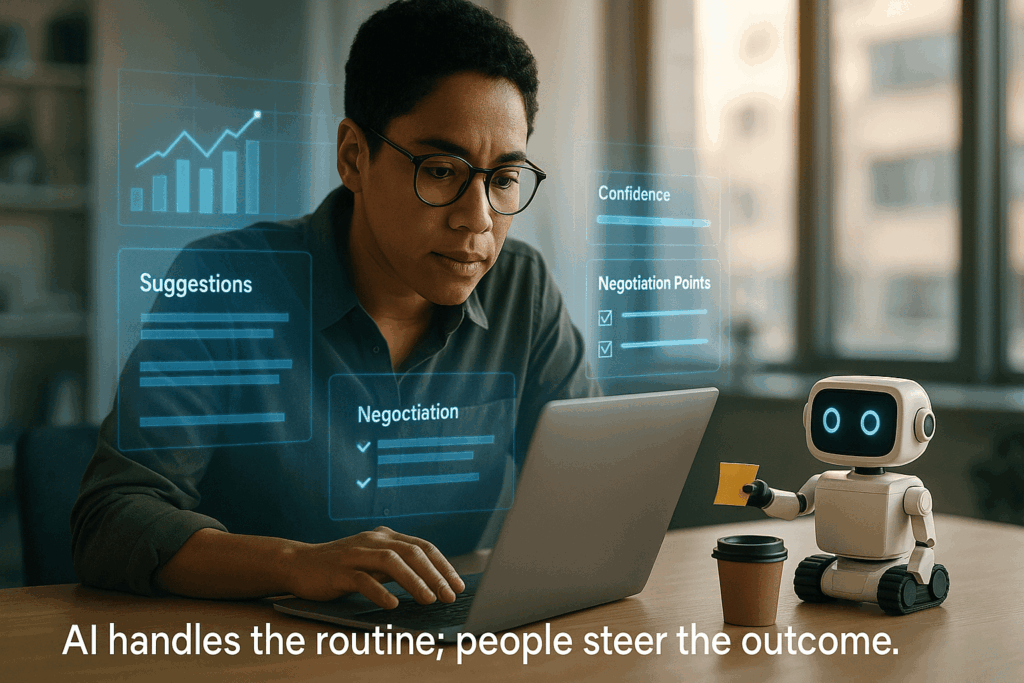
Staying relevant begins with upskilling. Data literacy, basic scripting, and a working grasp of AI prompts are quickly becoming the new table stakes. Affordable micro-courses on mainstream platforms or local university extensions can close most skill gaps. The second imperative is mindset: treat AI as a force multiplier, not a rival. Let Copilot draft that first-pass proposal so you can focus on tightening the argument; let generative design tools explore color palettes while you judge brand fit. Curiosity and willingness to re-tool will outperform static expertise every time.
Why Regulation Matters to Everyone’s Paycheck
Roughly 70 percent of U.S. GDP comes from consumer spending. If automation outstrips job creation, disposable income contracts and growth sputters. Thoughtful policy must therefore balance innovation with income stability: R&D credits to spur new tech, transparency rules for high-stakes AI decisions, and robust upskilling funds for displaced workers. Jurisdictions that strike that equilibrium will translate efficiency gains into durable prosperity rather than a short-term bump in margins.
Ethical and Practical Guardrails
Transparency, bias mitigation, and human oversight form the essential triad of responsible AI. Companies should publish plain-language model cards that list data sources, limitations, and intended uses. Diversified training sets, adversarial testing, and third-party audits help identify and address hidden biases before they reach production. Finally, any decision affecting a livelihood, such as loans, hiring, parole, or medical treatment, must still pass through human hands. These measures are not altruistic extras; they are brand-protection insurance.
Future Outlook
Expect an explosion of hybrid jobs such as AI operator, AI trainer, bias auditor, and automation strategist. Work will shift from executing tasks to orchestrating outcomes, where human context paired with machine pattern recognition produces an edge competitors cannot easily replicate.
Conclusion
AI will automate plenty, but it will not automate you unless you stand still. Focus on the parts of your work that require interpretation, persuasion, and ethical judgment, and let the algorithms shoulder the rote mechanics. If you are mapping pilot projects, governance frameworks, or workflow redesigns, CRES Technology can help chart the course. Otherwise, keep revisiting one deceptively simple question: Which parts of my role create value only a human can deliver? Answer it honestly, revisit it often, and you will stay ahead of the curve no matter how fast the models improve.
About Irfan Butt

CRES Technology – Founder and CEO
A strategic leader with over twenty years of progressive experience in Business Administration, Finance, Product Development, and Project Management. Irfan has a proven track record in a broad range of industries including hospitality, real estate, banking, finance, and management consulting.