Picture this: a client meeting in Manhattan is about to start, and the team is ready to present. Then someone cannot access a critical Microsoft 365 file. The clock keeps moving, the client is waiting, and the issue is suddenly bigger than a password reset. For New York businesses, that kind of disruption is not just inconvenient. It can affect client confidence, deadlines, and daily continuity. That is why managed IT services New York support models need to move beyond traditional helpdesk response and toward structured, proactive IT operations.
As founder and CEO of CRES Technology, I have seen how quickly ordinary support delays can become business issues in a market as fast-moving as New York. Traditional helpdesk models still have a role, but they are often too reactive for companies that depend on reliable access, secure collaboration, responsive support, and clear visibility into recurring technology problems.
What Are the Limitations of Traditional Helpdesk Models?
Traditional helpdesk models were built around receiving a ticket, troubleshooting the immediate issue, and closing the request. That can work for simple problems, but modern business technology is more connected and more security-sensitive. The limitations usually show up in practical ways:
- Reactive support: Traditional helpdesks typically wait for users to report problems, which can allow small issues to grow into larger disruptions. A minor access issue may point to a broader Microsoft 365 permissions or identity problem.
- Limited scalability: As businesses add employees, devices, applications, cloud services, and security requirements, a ticket-by-ticket approach can struggle to keep pace with hybrid teams and expanding IT environments.
- Inconsistent support quality: When knowledge is not documented, escalation paths are unclear, or recurring issues are not reviewed, support quality can vary from one request to the next.
- Operational delays: Slow resolution, unclear ownership, and fragmented communication can disrupt employees, delay client deliverables, and affect daily business continuity.
The issue is not that technicians lack skill. The issue is that the operating model often gives them too little structure, visibility, and business context.
Why Are NYC Businesses Facing Unique IT Challenges?
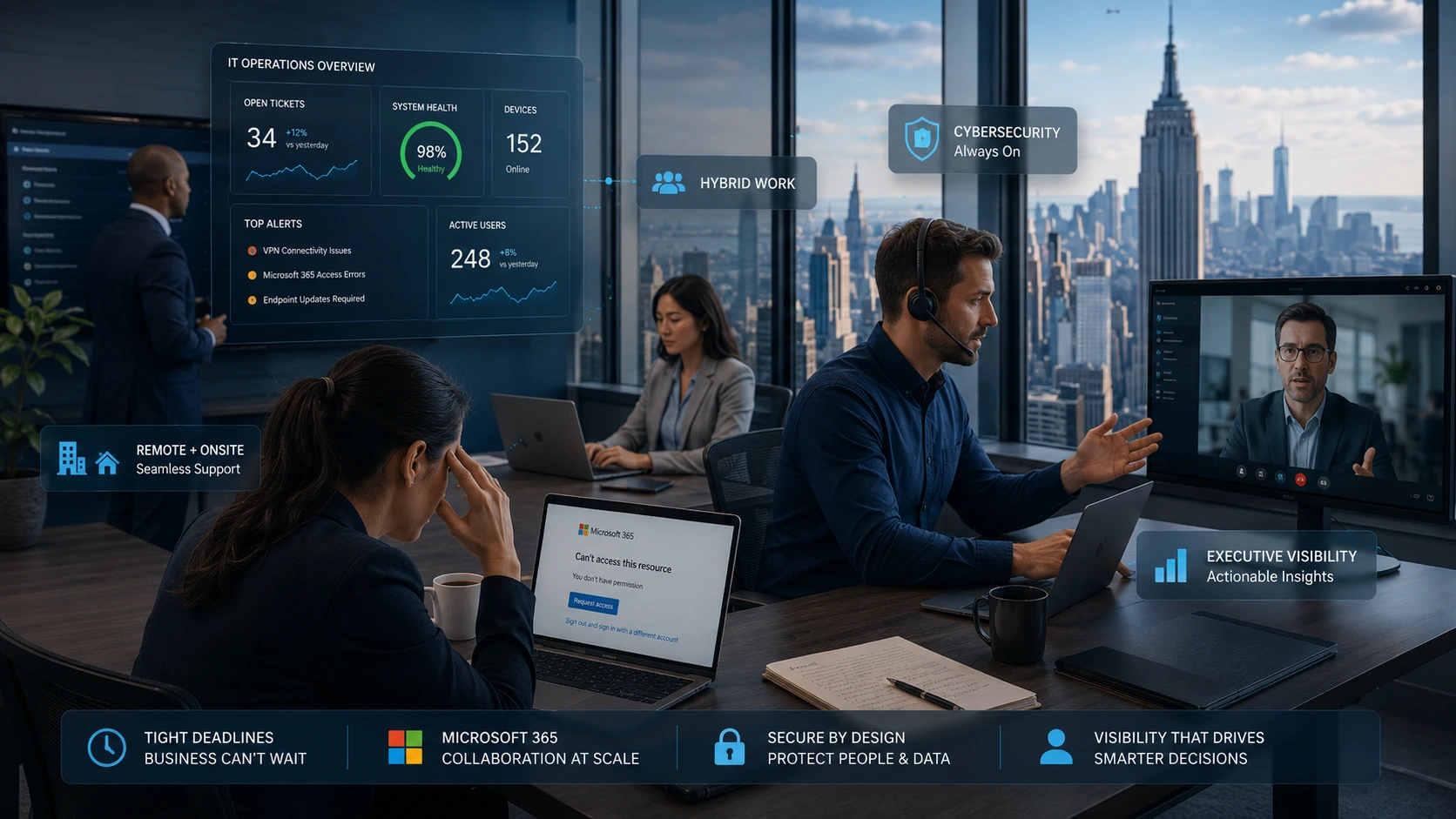
New York businesses operate in a dense, fast-paced environment where IT issues can become visible very quickly. Client meetings, hybrid work, tight timelines, multi-location operations, and compliance-sensitive workflows leave little room for support models that depend only on reactive tickets.
- High demand for fast resolution: Teams often work under tight client deadlines. A delayed response to an access, device, or network issue can affect productivity and client service.
- Complex IT environments: Microsoft 365, Teams, SharePoint, OneDrive, endpoint devices, remote users, cloud applications, and office technology all need coordinated management.
- Cybersecurity pressure: Phishing, identity misuse, endpoint vulnerabilities, weak access controls, and backup gaps require steady operational discipline. Resources like CISA Cyber Guidance for Small Businesses can help smaller organizations understand practical security steps.
- Remote and onsite coordination: Many issues can be resolved remotely, but devices, networks, office moves, and meeting-room technology may still require onsite support.
- Need for executive visibility: Leaders need to understand which problems repeat, who owns them, and what needs to be fixed at the root.
This is where managed IT support New York needs to be more than a helpdesk queue. It needs to connect support activity with monitoring, documentation, security, and planning.
What Happens When IT Support Fails to Keep Up?
When IT support cannot keep pace with the business, the impact shows up across operations. The most visible issue may be a ticket, but the underlying cost is often lost time, avoidable risk, and reduced confidence in the systems people depend on.
- Lost productivity: Employees lose time when access, devices, applications, or networks do not work reliably. Repeated Microsoft 365 issues can slow communication and delay work.
- Client-service friction: Technology problems can affect meetings, deliverables, response times, and the customer experience.
- Security exposure: Slow support and weak processes can leave identity, endpoint, email, backup, and access risks unresolved.
- Recurring disruption: A ticket may be closed, but if the root cause is not reviewed, the same problem is likely to return.
Modern support should help the business see patterns, not just close individual requests.
What Does Modern IT Support Look Like?
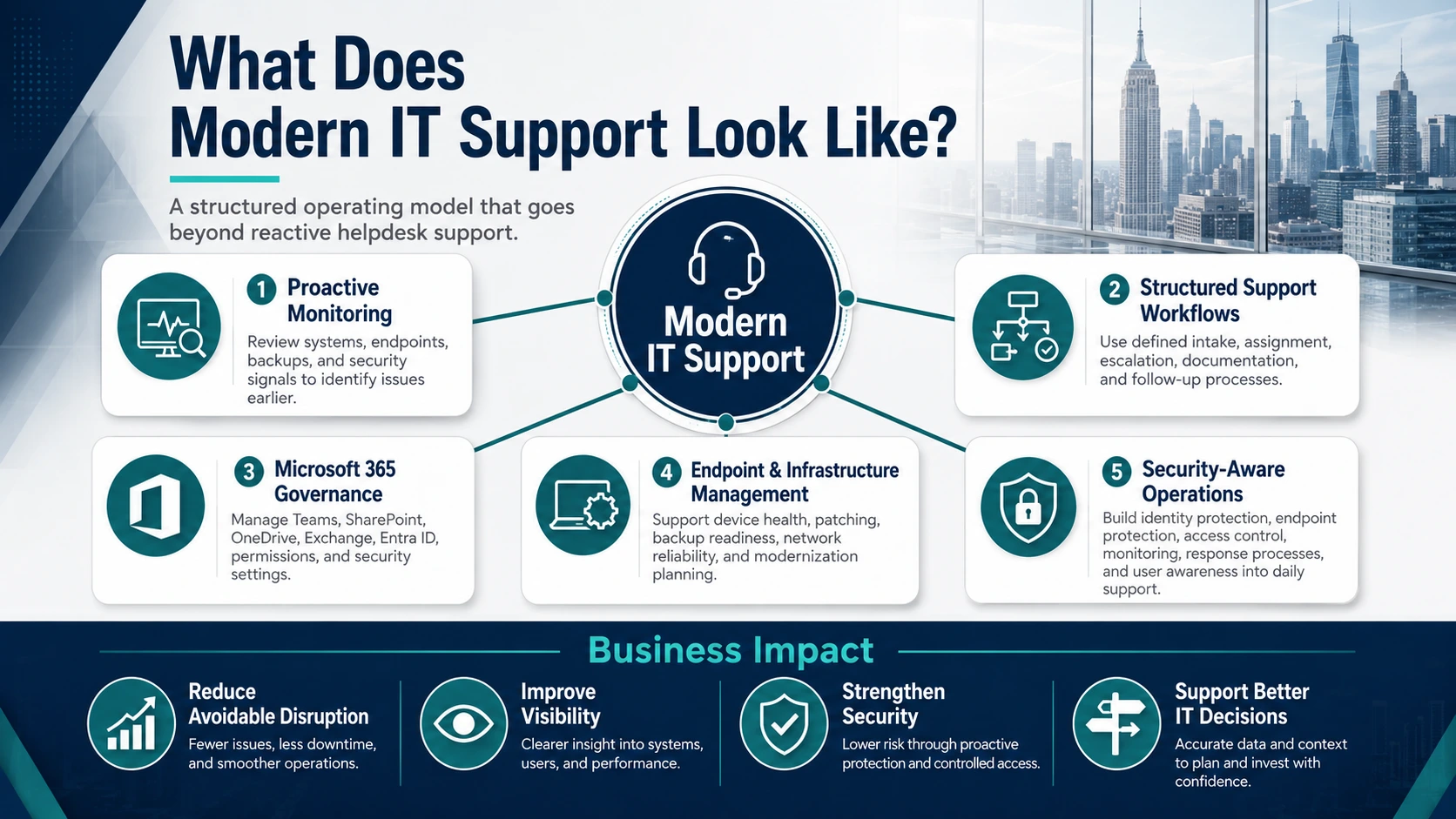
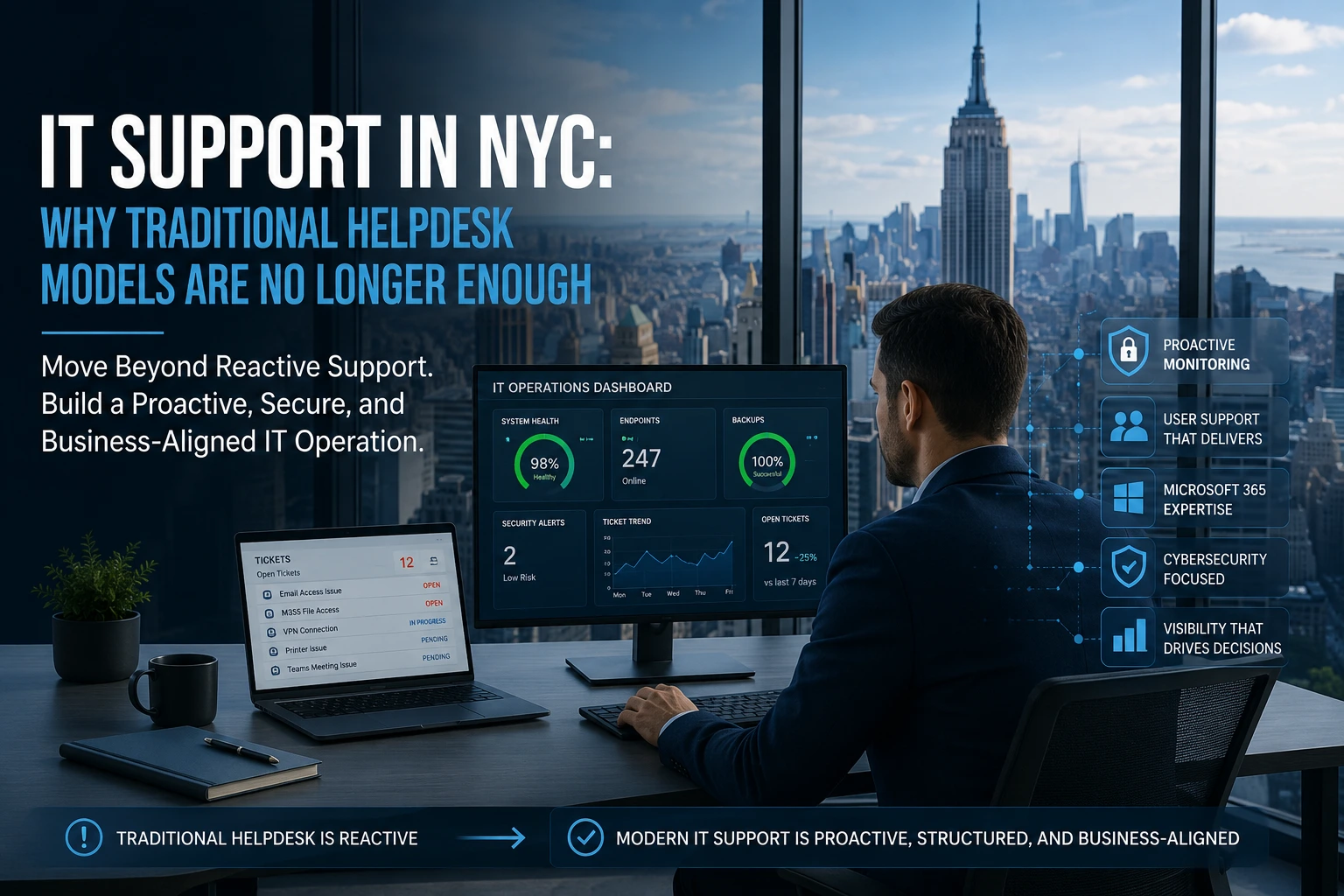
Modern IT support is a structured operating model that combines helpdesk response with monitoring, documentation, Microsoft 365 administration, infrastructure management, cybersecurity practices, and business reporting. For companies evaluating managed IT New York options, the difference is usually visible in how support is organized.
- Proactive monitoring: Systems, endpoints, backup status, and security signals are reviewed so issues can be identified earlier.
- Structured support workflows: Intake, assignment, escalation, documentation, and follow-up processes improve consistency.
- Microsoft 365 governance: Teams, SharePoint, OneDrive, Exchange, Entra ID, permissions, and security settings need practical administration.
- Endpoint and infrastructure management: Device health, patching, backup readiness, network reliability, and modernization planning should be part of daily IT operations.
- Security-aware operations: Identity protection, endpoint protection, access control, monitoring, response processes, and user awareness should be built into the support model.
The goal is not to promise that every issue can be prevented. The goal is to reduce avoidable disruption, improve visibility, and give leaders better information for IT decisions.
How Can Managed IT Services Help NYC Businesses Move Beyond the Helpdesk?
Managed IT services New York providers can help businesses combine day-to-day user support with broader operational discipline. That matters because support tickets, security alerts, Microsoft 365 administration, device management, and business continuity are connected in practice.
- Reliable support coverage: Clear processes for user issues, escalation, documentation, and follow-up help make support more consistent.
- Better visibility: Reporting can help leaders understand recurring problems, delayed issues, system health, and operational risks.
- Security and continuity planning: Practical cybersecurity operations, backup readiness, and response planning help businesses prepare without relying on unrealistic guarantees.
- Remote and onsite flexibility: A stronger support model coordinates remote troubleshooting and onsite assistance for physical devices, networks, office moves, and meeting-room needs.
- Strategic IT guidance: Managed service providers can help businesses plan improvements, prioritize risks, manage vendors, and align technology decisions with business goals.
For NYC businesses, the value is not only faster ticket handling. The value is a more organized view of how technology supports operations, clients, and growth.
Where CRES Technology Fits
CRES Technology has been serving New York customers for decades, with both Onsite as well as Remote support. We help businesses manage, secure, and improve their IT environments. Our services include Managed IT, Microsoft 365 Support, Cybersecurity Services, Infrastructure Services, Virtual CIO guidance, Onsite Support, and Staff Augmentation.
Our approach focuses on structured support processes, documented troubleshooting patterns, Microsoft 365 administration, cybersecurity discipline, operational reporting, and human-reviewed AI-assisted tools. AI can help organize information and identify patterns, but experienced engineers still need to validate recommendations, communicate with users, and handle complex or high-impact issues.
For businesses looking at managed IT support New York options, the practical question is whether the provider can connect daily support with security, documentation, governance, and business visibility.
Conclusion
Traditional helpdesk models are no longer enough for NYC businesses where technology is central to productivity, client service, security, and continuity. Modern IT support needs a more proactive and structured approach that reduces recurring issues, strengthens security practices, supports Microsoft 365 operations, and gives leaders better visibility.
If your current support model only reacts to tickets, it may be time to evaluate whether it is giving your business the operational clarity and responsiveness it needs today.
About Irfan Butt

CRES Technology – Founder and CEO
A strategic leader with over twenty years of progressive experience in Business Administration, Finance, Product Development, and Project Management. Irfan has a proven track record in a broad range of industries, including hospitality, real estate, banking, finance, and management consulting.