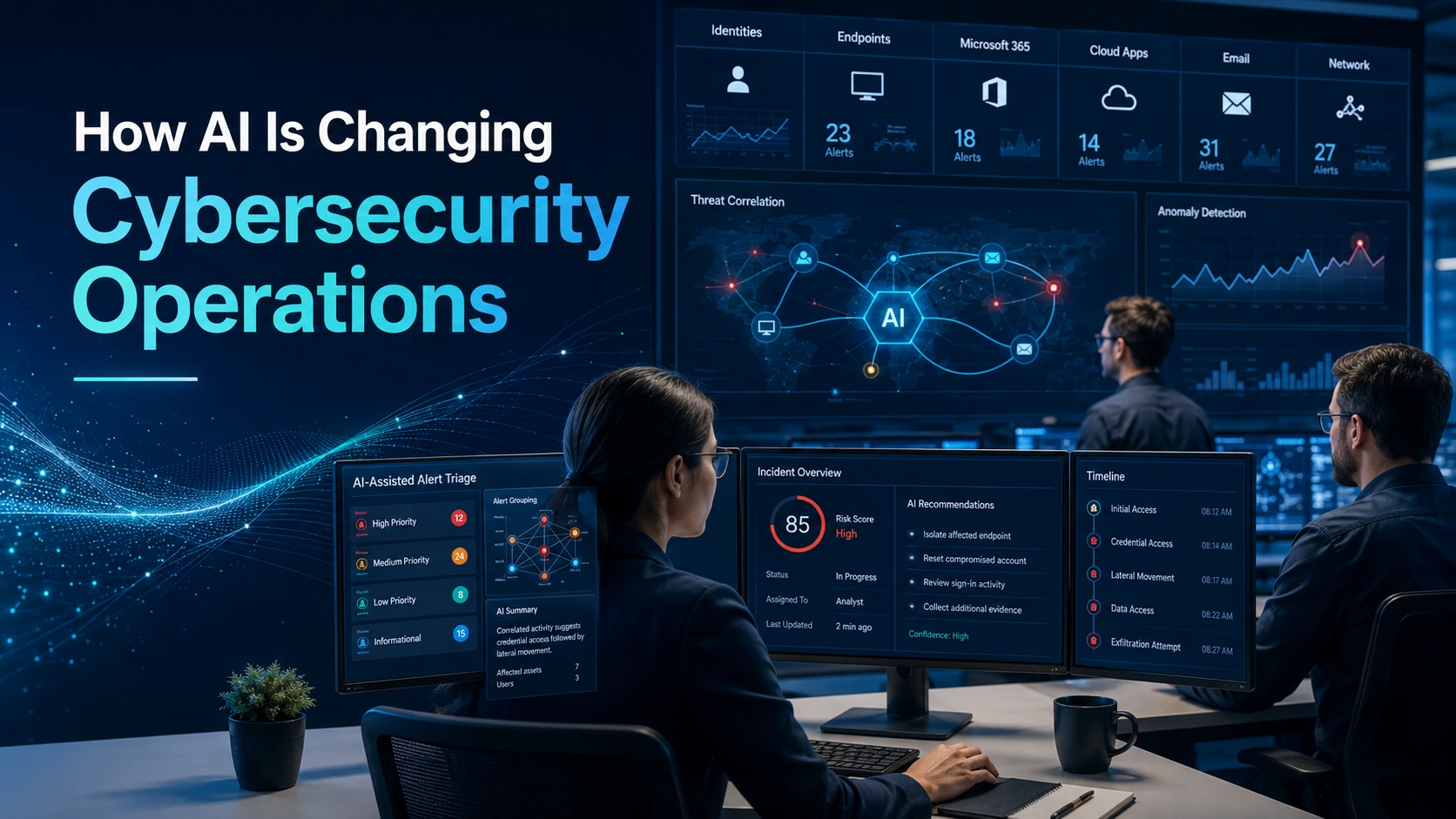
Cybersecurity teams are under pressure from two directions at once. Attackers are moving faster, while business systems now span Microsoft 365, endpoints, cloud applications, remote users, identity platforms, and third-party tools. For many organizations, the question is no longer whether they have security tools. The harder question is whether anyone can interpret the alerts, connect the patterns, and respond before small signals turn into larger incidents.
As Director of IT Services at CRES Technology, I have seen how quickly security operations can become overwhelming when teams rely only on manual review and reactive tools. A strong password, a firewall, and basic monitoring are no longer enough on their own. Modern managed cybersecurity services increasingly use AI-assisted analysis to help detect suspicious behavior, prioritize alerts, reduce noise, and support faster decision-making.
AI does not replace skilled security professionals. It gives them better context. When used responsibly, AI can help cybersecurity teams identify unusual behavior, correlate signals across systems, and focus attention on the events that deserve human review.
What Challenges Do Traditional Cybersecurity Operations Face?
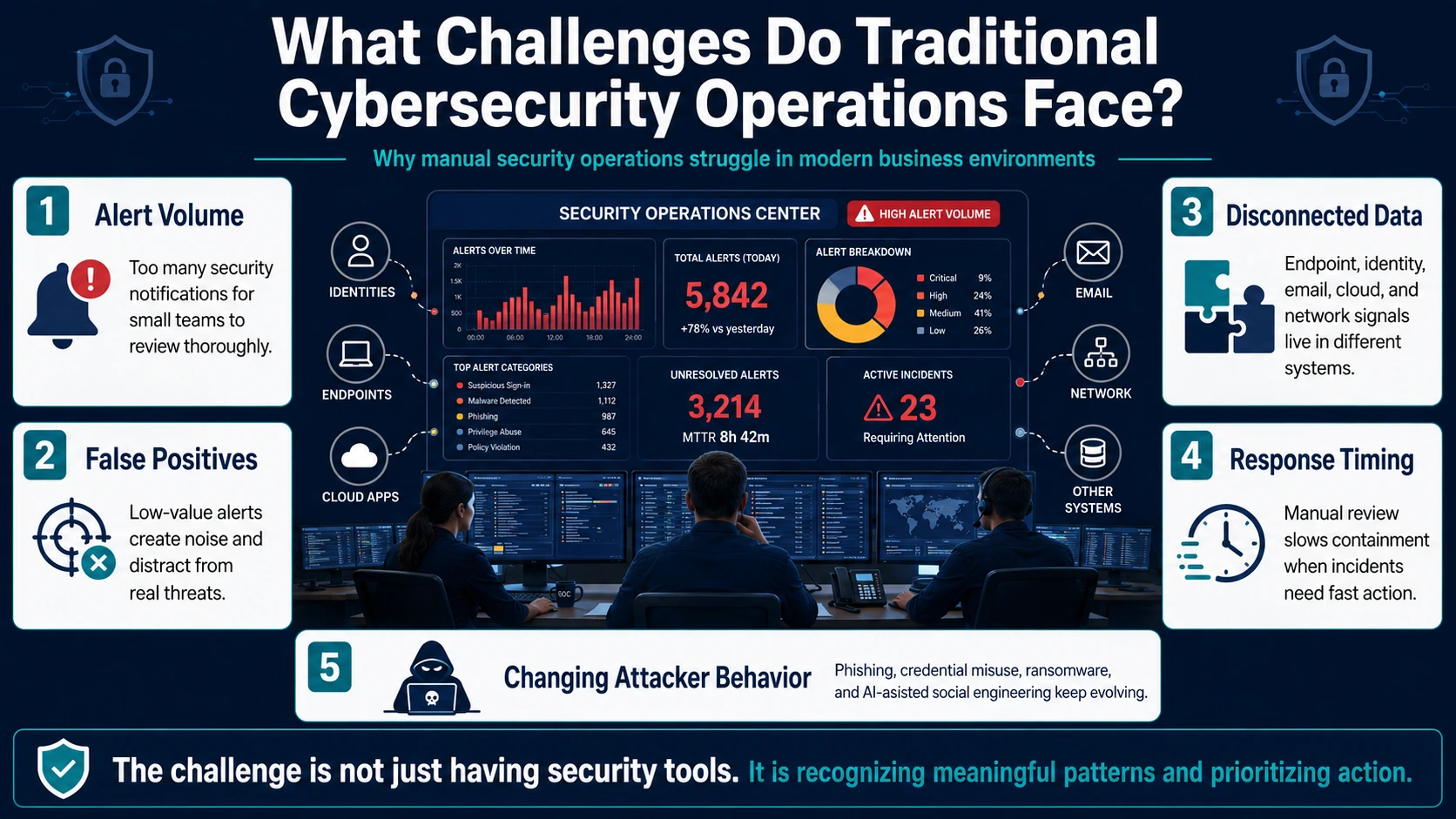
Traditional cybersecurity operations often depend on people manually reviewing logs, alerts, dashboards, and incident reports. That model becomes difficult when a business is generating thousands of signals across endpoints, identities, cloud services, email, network tools, and security platforms.
The most common challenges include:
- Alert volume: Security tools can generate more notifications than a small IT team can investigate thoroughly.
- False positives: Too many low-value alerts can distract from real risk.
- Disconnected data: Endpoint, identity, email, cloud, and network events may live in different systems.
- Response timing: Some incidents require quick containment, but manual review can slow the first steps.
- Changing attacker behavior: Phishing, credential misuse, ransomware, and AI-assisted social engineering continue to evolve.
For business owners and executives, the operational problem is clear. A security program cannot rely only on people reading every alert after the fact. Teams need better ways to recognize meaningful patterns and prioritize action.
How Is AI Transforming Cybersecurity Operations?
AI is changing cybersecurity operations by helping teams process more security signals with better speed and context. It is most useful when it supports a structured security process rather than acting as an independent decision-maker.
Practical AI use cases include:
- Behavioral analysis: AI can help identify unusual login behavior, device activity, access patterns, or data movement that may deserve review.
- Anomaly detection: AI-assisted tools can compare current activity against expected patterns and flag outliers for investigation.
- Alert triage: AI can help sort alerts by severity, affected system, user role, known patterns, and likely business impact.
- Threat intelligence correlation: AI can help connect internal signals with known indicators, suspicious domains, or emerging attack patterns.
- Incident response support: AI can summarize events, suggest next investigation steps, and help teams document what happened.
These capabilities can help security teams spend less time sorting noise and more time investigating real risk. That is especially valuable for organizations that do not have a large internal security operations center.
How Are Attackers Using AI Too?
AI is not only helping defenders. Attackers can also use AI to make phishing messages more convincing, test social engineering variations, automate reconnaissance, and adapt content for specific roles or industries. That does not mean every attack is advanced, but it does mean businesses should expect more polished and targeted attempts.
This is one reason cybersecurity operations need more than basic blocking tools. Teams need visibility into identity activity, endpoint behavior, email threats, cloud access, and unusual user actions. They also need a clear process for reviewing alerts and escalating events that may indicate a real compromise.
What Are The Limits Of AI In Cybersecurity?
AI can improve cybersecurity operations, but it is not a silver bullet. It can misread context, surface false positives, miss weak signals, or produce recommendations that require careful review. It also depends heavily on the quality of the data, tools, policies, and response process around it.
Businesses should be cautious about any message that promises complete protection, breach elimination, or cybersecurity operations without human expertise. The stronger model is human-led security supported by AI-assisted analysis.
Important limits include:
- Data quality: Poor logging, incomplete endpoint visibility, and disconnected tools can limit AI value.
- Context gaps: AI may not understand business priorities, regulatory considerations, or operational tradeoffs.
- Over-reliance: Teams still need skilled people to validate findings, approve actions, and communicate with stakeholders.
- Adversarial use: Attackers can attempt to manipulate systems, evade detection, or use AI to improve their own tactics.
What Are The Business Benefits Of AI-Enabled Cybersecurity Services?
For small and midsize businesses, AI-enabled cybersecurity is not about chasing buzzwords. It is about improving the operating rhythm of security work. A strong cyber security as a service approach can combine tools, monitoring, response workflows, reporting, and expert oversight so leaders have a clearer view of risk.
Potential benefits include:
- Better visibility: Teams can connect events across identities, endpoints, email, cloud tools, and network activity.
- Faster prioritization: AI can help identify which alerts may deserve attention first.
- More consistent response: Documented workflows help teams investigate, escalate, and close incidents more reliably.
- Reduced alert fatigue: Better triage can help teams focus on meaningful events instead of every notification.
- Improved planning: Trend reporting can support decisions around user training, endpoint management, Microsoft 365 security, and security policy improvements.
These benefits should be presented as operational improvements, not as guaranteed outcomes. AI can support better cybersecurity operations, but the result still depends on implementation quality, monitoring discipline, and expert judgment.
How Can Businesses Start Using AI In Cybersecurity Responsibly?
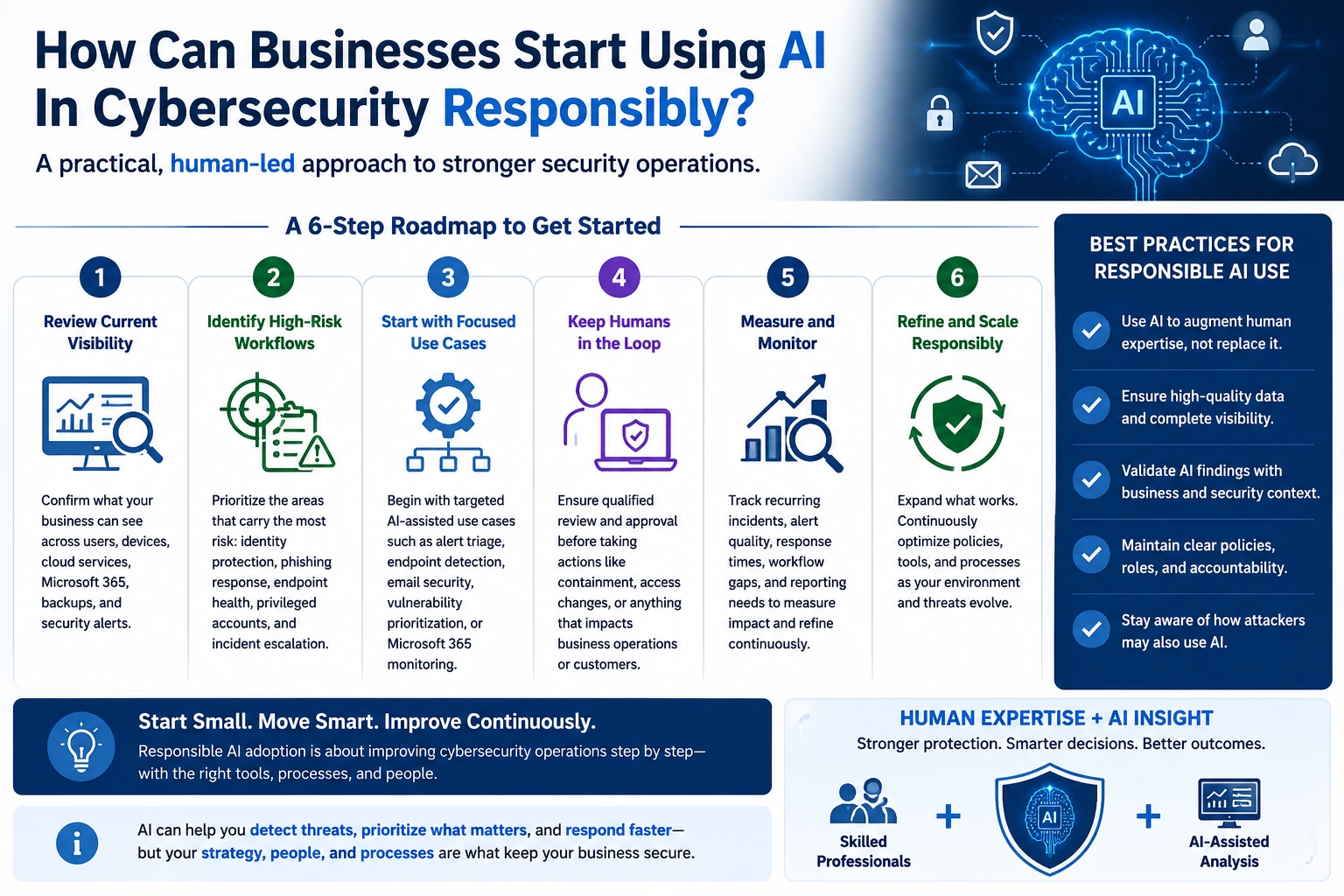
Businesses do not need to adopt every AI security tool at once. A practical starting point is to identify where the current security process creates the most risk or delay.
- Review current visibility: Confirm what the business can see across users, devices, cloud services, Microsoft 365, backups, and security alerts. For practical small-business security guidance, see CISA’s Cyber Guidance for Small Businesses.
- Identify high-risk workflows: Prioritize identity protection, phishing response, endpoint health, privileged accounts, and incident escalation.
- Start with focused use cases: Consider AI-assisted alert triage, endpoint detection, email security, vulnerability prioritization, or Microsoft 365 monitoring.
- Keep humans in the loop: Require qualified review before containment, access changes, policy changes, or customer-impacting actions.
- Measure and refine: Track recurring incidents, alert quality, response workflow gaps, and reporting needs.
Where CRES Technology Fits
CRES Technology helps businesses manage, support, secure, and improve their IT environments. Relevant service areas may include Managed IT Services, Microsoft 365 Support, Cybersecurity Services, Infrastructure Services, Virtual CIO, Onsite Support, and Staff Augmentation.
For organizations evaluating AI-enabled cybersecurity services, CRES can help review security operations, improve monitoring practices, strengthen Microsoft 365 and endpoint visibility, and build practical response workflows. The goal is not to replace people with AI. The goal is to give experienced IT and cybersecurity professionals better information, faster context, and a clearer process for protecting the business.
Conclusion
AI is changing cybersecurity operations by helping teams detect patterns, prioritize alerts, correlate threat signals, and respond with better context. At the same time, attackers are using AI to improve phishing, reconnaissance, and social engineering. Businesses should treat AI as part of a broader security operating model that includes expert oversight, strong identity controls, endpoint visibility, monitoring, response planning, and continuous improvement.
The future of cybersecurity is not AI alone. It is AI-assisted operations guided by people who understand both technology risk and business impact.