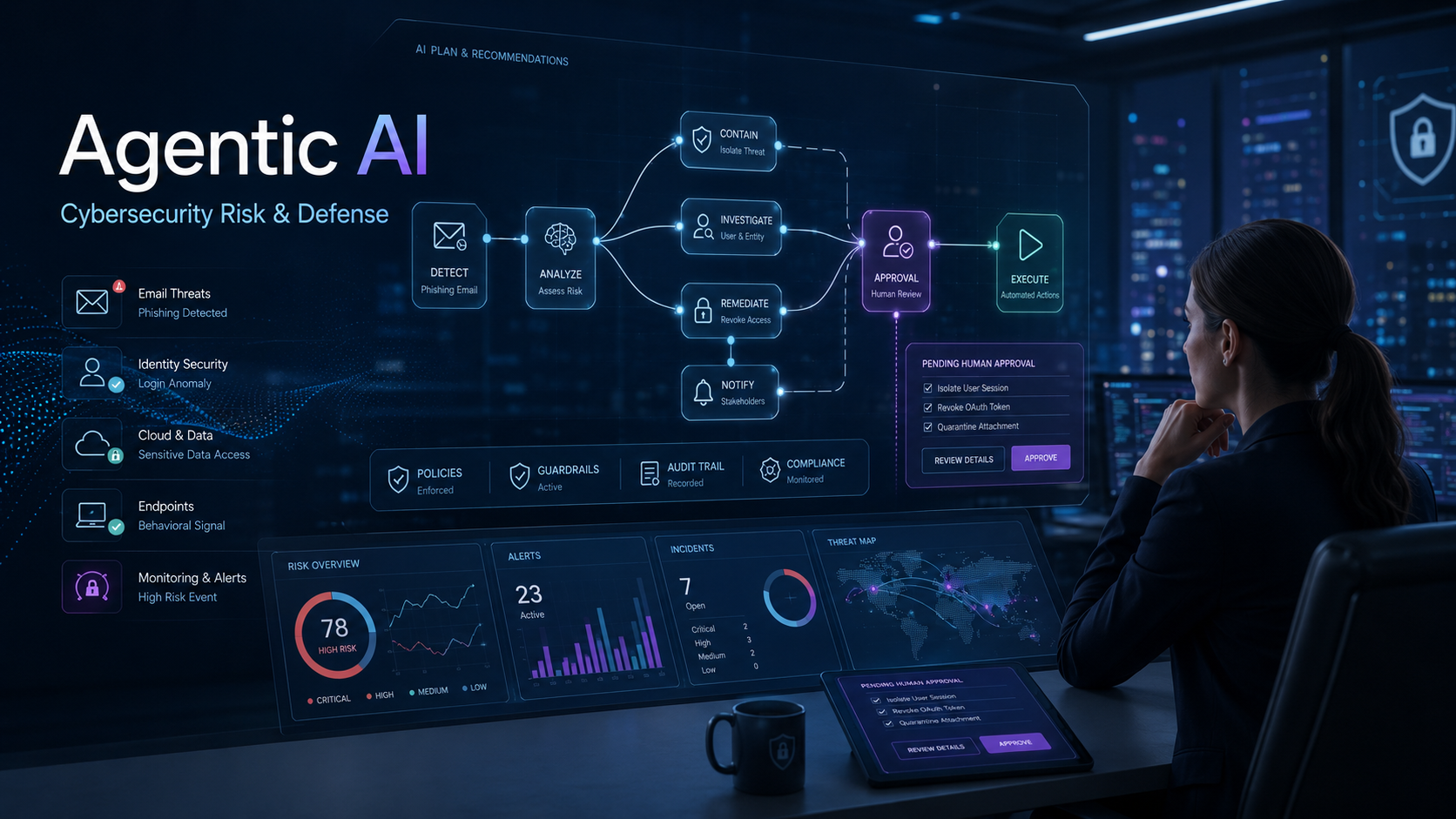
Imagine asking an AI assistant to summarize a meeting, only to receive a detailed action plan with follow-ups, deadlines, and suggested tools. That capability can be useful, but it also creates a serious cybersecurity question: what happens when AI systems can plan, act, and adapt faster than a person can review every step? For organizations using managed cybersecurity services, agentic AI is becoming both a defensive opportunity and a new risk category that requires governance, monitoring, and practical human oversight.
As founder and CEO of CRES Technology, I have seen how AI is reshaping the cybersecurity landscape. Agentic AI, with its ability to plan and execute multi-step actions, is changing how businesses think about phishing, reconnaissance, credential abuse, vulnerability discovery, data exposure, and incident response. The priority is not to treat AI as a replacement for security judgment. The priority is to understand where autonomous systems can help, where they can fail, and how organizations should control their use.
What Is Agentic AI and Why Does It Matter in Cybersecurity?
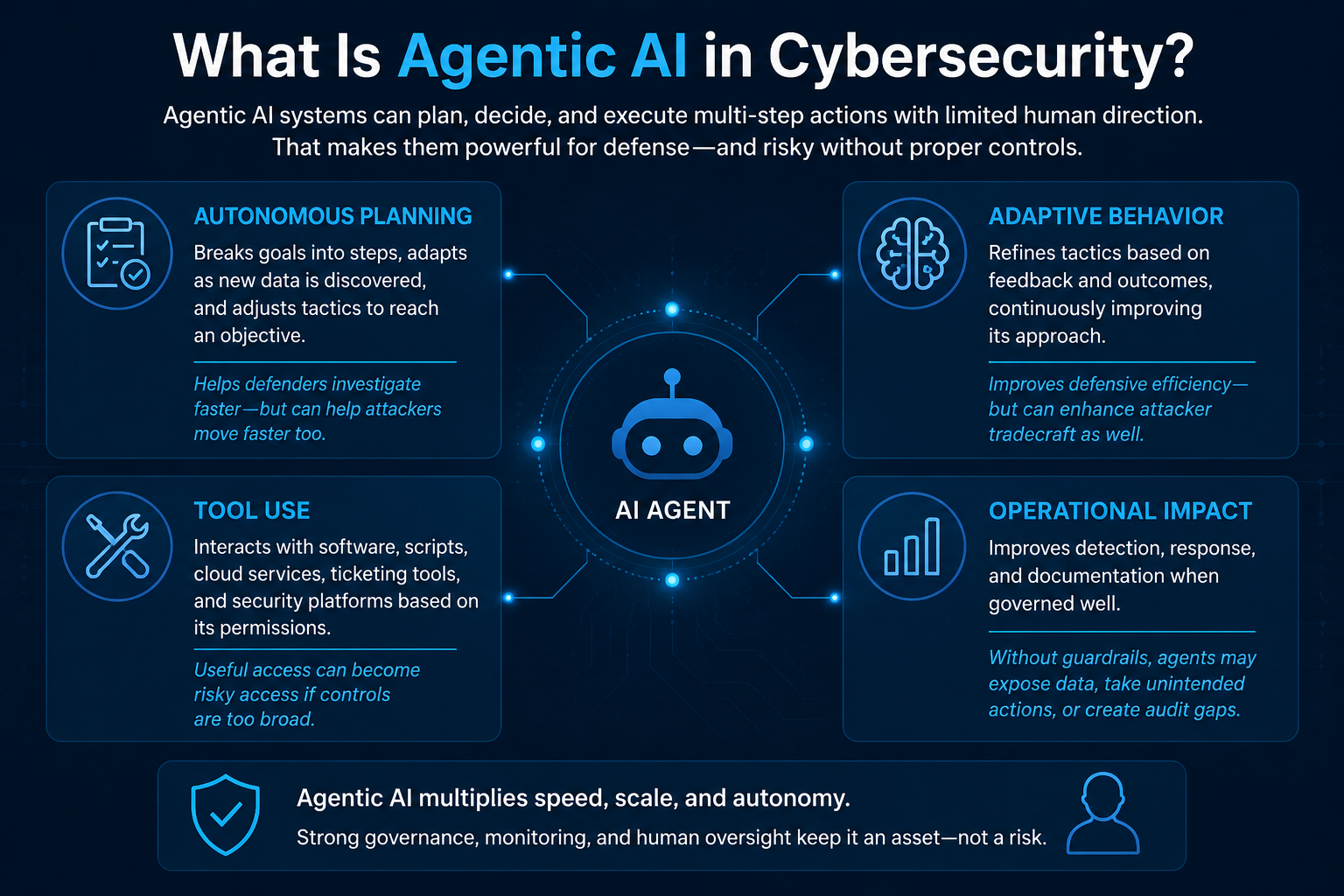
Agentic AI refers to systems designed to plan, make decisions, and execute multi-step actions with limited human direction. Unlike traditional AI tools that usually respond to a single prompt or task, agentic systems can use tools, gather information, adjust their approach, and continue working toward a goal. That makes them relevant to cybersecurity because many attacks and defenses already involve multi-step workflows.
- Autonomous planning: Agentic AI can break a goal into steps and adjust its approach as it gathers new data. In a security context, this could include identifying exposed systems, reviewing configuration gaps, or testing a sequence of actions.
- Tool use: These systems may interact with software, scripts, cloud services, ticketing tools, or security platforms depending on their permissions and configuration. Useful access can become risky access if controls are too broad.
- Adaptive behavior: Agentic AI can refine tactics based on feedback. That can help defenders investigate faster, but it can also help attackers improve phishing, reconnaissance, and exploitation attempts.
- Operational impact: AI-assisted workflows can improve detection, response, and documentation, but poorly governed agents may expose sensitive data, take unintended actions, or create audit gaps.
The speed, scale, and autonomy of agentic AI make it important for cybersecurity planning. Businesses need to evaluate both the productivity benefit and the control model around any AI system that can act across business data or technical environments.
How Does Agentic AI Introduce New Cybersecurity Risks?
Agentic AI does not replace traditional cybersecurity risk. It amplifies familiar risks by making them faster, more automated, and harder to review manually. The concern is not only what AI can generate, but what it can do when connected to tools, identities, files, and workflows.
- AI-assisted phishing: Attackers can use AI to create convincing Microsoft 365 login prompts, payment-change requests, vendor messages, or executive impersonation emails. These messages can mimic tone, context, and urgency more effectively than generic phishing attempts.
- Automated reconnaissance: AI tools can gather public information about companies, employees, vendors, exposed systems, and technology stacks. That information can help attackers map potential weaknesses faster.
- Credential abuse: Autonomous workflows can accelerate attempts to test stolen credentials, exploit weak identity controls, or abuse active sessions if monitoring and conditional access are weak.
- Vulnerability discovery: AI can help identify misconfigurations, exposed services, and software weaknesses, especially in environments with inconsistent patching, logging, or review processes.
- Tool misuse: AI agents with broad access may take unintended actions, connect systems in risky ways, expose sensitive data, or make changes without enough approval control.
Most businesses are not facing fully autonomous attacks every day, but the direction is clear. AI can increase attack speed and reduce the effort required to scale familiar tactics.
Can Agentic AI Create Bias, Governance, or Accountability Problems?
Beyond technical threats, agentic AI raises governance and accountability questions. Cybersecurity leaders need to know who owns AI-driven actions, what data an AI system can access, which decisions require human approval, and how the organization will audit what happened after an incident.
- Biased or incomplete data: If an AI system learns from incomplete or skewed data, it may prioritize the wrong risks, miss important signals, or recommend actions that do not fit the business environment.
- Unclear accountability: Organizations need defined ownership for AI-assisted security actions, including who reviews alerts, approves access decisions, validates recommendations, and escalates incidents.
- Over-automation: Defensive systems that act too aggressively can disrupt legitimate work, block users unnecessarily, or create confusion during incidents.
- Auditability: Security teams need logs, approval trails, configuration records, and review procedures so AI-assisted decisions can be explained and improved.
Governance is not paperwork around the edge of the problem. It is the mechanism that keeps AI-assisted cybersecurity useful, accountable, and aligned with business risk.
How Can Organizations Defend Against Agentic AI Threats?
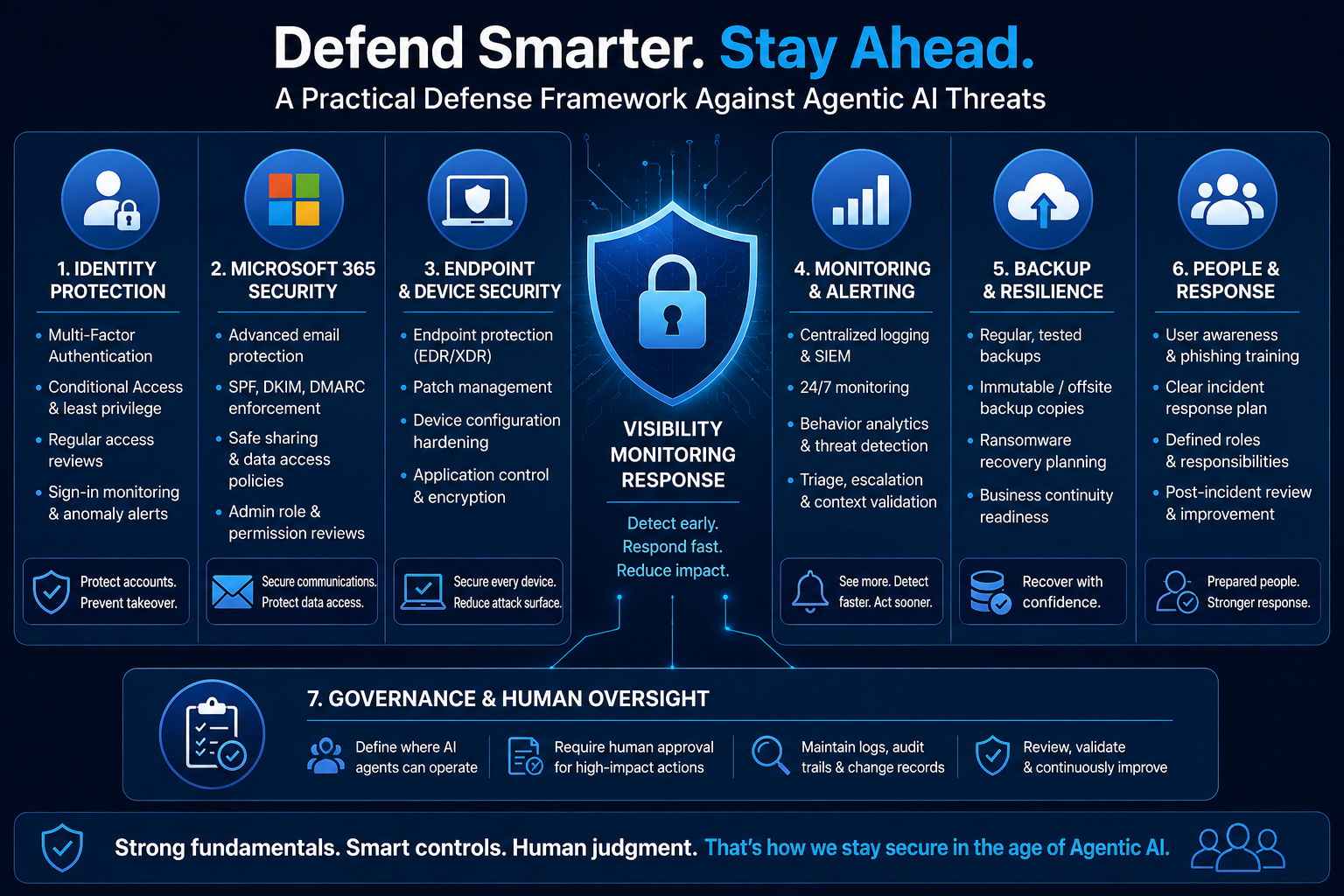
Defending against agentic AI threats requires practical security fundamentals, clearer ownership, and better visibility. AI changes the speed of the problem, but the foundation still depends on identity protection, Microsoft 365 controls, endpoint coverage, monitoring, backup readiness, employee awareness, and response planning.
- Identity protection: Use multi-factor authentication, conditional access, role-based permissions, periodic access reviews, and sign-in monitoring to reduce account takeover risk.
- Microsoft 365 security: Review email protection, SPF, DKIM, DMARC, risky sign-in alerts, sharing controls, administrator permissions, and data access policies.
- Endpoint and monitoring coverage: Combine endpoint protection, logging, alert review, and escalation procedures so unusual activity is visible and acted on.
- Employee awareness: Train employees to verify unusual requests, report suspicious messages, and avoid relying on tone or grammar as proof that a message is legitimate. For practical guidance, see CISA’s Cyber Guidance for Small Businesses.
- Incident response planning: Document roles and responsibilities for reviewing alerts, making decisions, contacting vendors, preserving evidence, and maintaining operations during an incident.
- Managed oversight: Consider cyber security as a service when the business needs ongoing monitoring, configuration review, response support, and security guidance without building every capability internally.
The goal is not to block every possible AI-driven threat before it exists. The goal is to reduce exposure, improve visibility, and make response decisions faster and more consistent.
Where Managed Cybersecurity Services Fit
Managed cybersecurity services help businesses prepare for agentic AI risks by turning security from a collection of tools into an operating discipline. A managed provider should focus on visibility, prioritization, monitoring, response readiness, and continuous improvement rather than unrealistic prevention claims.
- Assessment and prioritization: Review the current environment, identify gaps, and focus on controls that reduce meaningful business risk.
- Security configuration: Improve Microsoft 365, identity, endpoint, backup, and access settings so core controls are not left to chance.
- Monitoring and escalation: Review alerts, identify suspicious activity, and escalate issues through defined procedures.
- Governance support: Help leaders decide where AI tools should be allowed, how access should be limited, and which actions require human approval.
- Continuous improvement: Adjust security practices as threats, tools, compliance needs, and business operations change.
For growing businesses, managed cybersecurity support can make security more consistent and visible without requiring an internal team to handle every control, alert, and policy decision alone.
Where CRES Technology Fits
CRES Technology helps businesses manage, support, secure, and improve their IT environments. Our services include Managed IT Services, Microsoft 365 Support, Cybersecurity Services, Infrastructure Services, Virtual CIO guidance, Onsite Support, and Staff Augmentation.
Our cybersecurity support includes Microsoft 365 security configuration, identity and access controls, endpoint protection, monitoring, backup readiness, response planning, and user awareness training. We also use structured processes and AI-assisted tools where they improve visibility, consistency, and response readiness. AI can help organize signals and recommendations, but experienced professionals still validate context, make risk decisions, and handle complex incidents.
For organizations evaluating managed cybersecurity services, the right model should combine practical controls, clear reporting, human review, and a security roadmap that evolves as AI-related risks change.
Conclusion
Agentic AI is not just a technology trend. It is a cybersecurity planning issue that requires attention from leadership, operations, and IT. Businesses need to evaluate whether their current security approach provides enough visibility into identity risks, Microsoft 365 configuration, endpoint protection, monitoring, employee reporting, incident response, and AI governance.
Organizations that address these fundamentals will be better prepared for the next stage of AI-driven risk and defense. Agentic AI will continue to change the threat landscape, but disciplined security operations, managed oversight, and accountable human review remain essential.