Managed IT Support for SMBs is changing quickly, but not in the cartoon version where a robot walks in, fixes the printer, updates Microsoft 365 permissions, and politely tells everyone to reboot. As the Director of IT Services at CRES Technology, I see AI becoming most useful when it helps support teams find better context, spot patterns faster, and make fewer avoidable mistakes.
That distinction matters. AI is not replacing skilled IT professionals. It is changing how support teams triage issues, document fixes, identify recurring problems, monitor environments, and guide users through common requests. For small and mid-sized businesses, the next three years will be less about handing IT support to AI and more about building a more structured, responsive, and data-informed support model.
What Role Does AI Currently Play in IT Support?
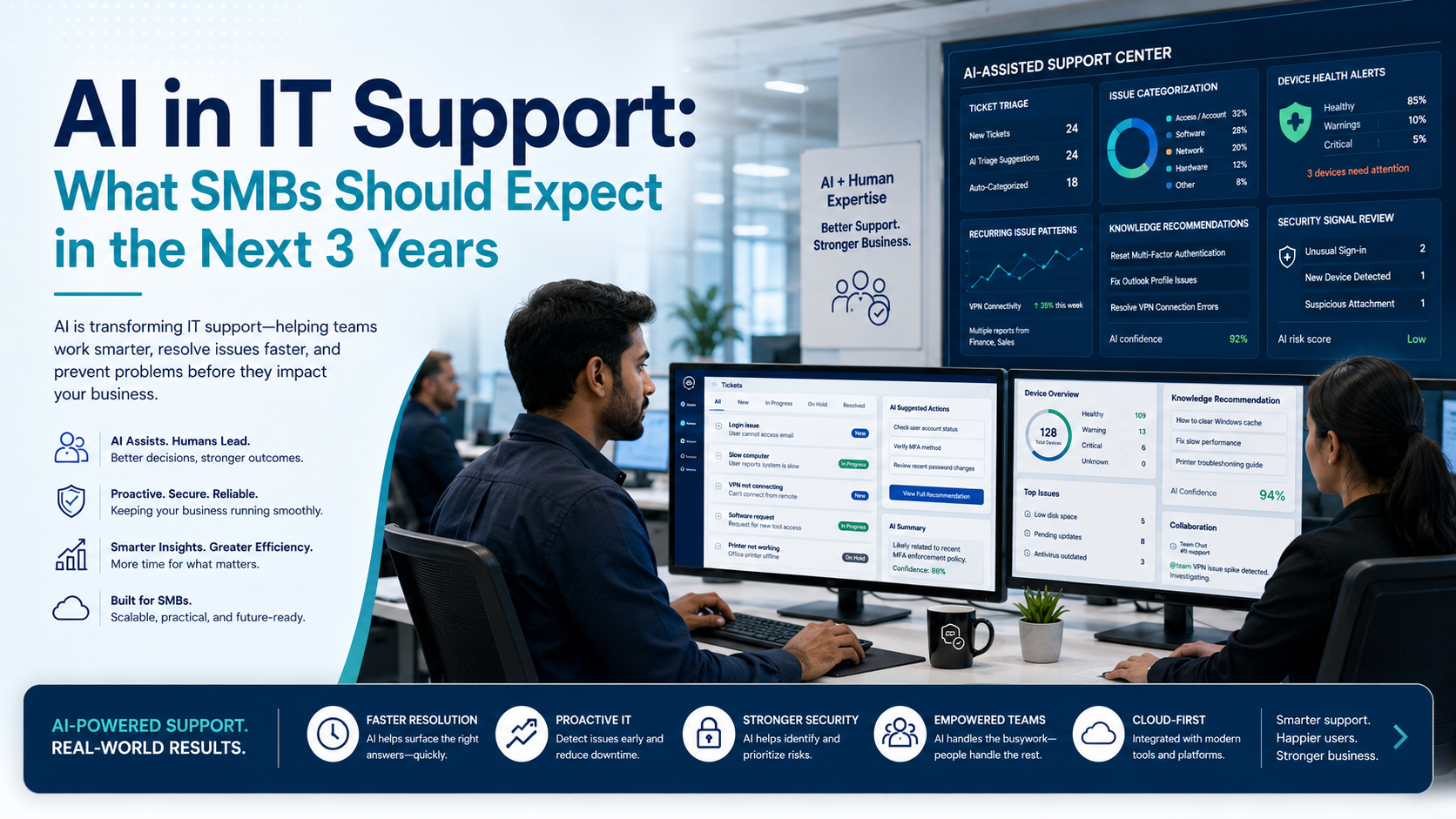
AI is already present in IT support, though its value depends on how carefully it is implemented. The best use cases are practical: reducing repetitive work, improving context for engineers, and helping teams respond with more consistency.
- Ticket triage: AI-assisted systems can help categorize requests, identify urgency, and route issues to the right support path more quickly.
- Knowledge base recommendations: Support engineers can receive suggested troubleshooting steps based on prior tickets, known patterns, and documented procedures.
- Self-service for common issues: Users may get guided help for routine tasks such as password resets, basic connectivity checks, or application access questions.
- Pattern detection: AI can help surface repeated issues across devices, users, applications, or locations so the support team can look for root causes.
- Security signal review: AI-assisted tools may help identify unusual login behavior, endpoint alerts, or activity patterns that deserve human review.
These capabilities are useful, but they still require oversight. AI can suggest, categorize, and summarize. Experienced engineers still need to validate the issue, understand business impact, and decide the correct response.
What AI Trends Will Shape IT Support in the Next 3 Years?
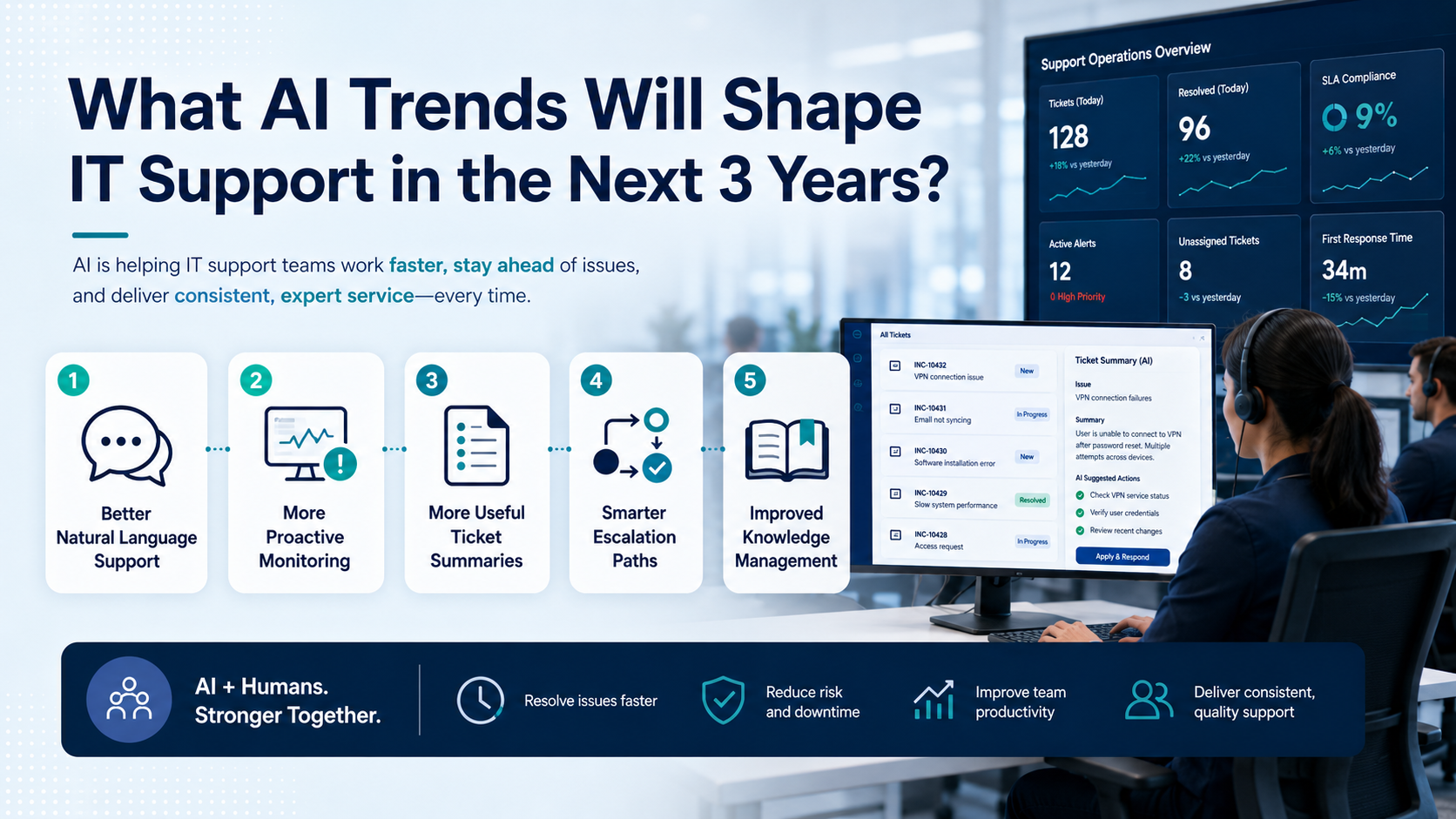
For SMBs, the most useful AI improvements will likely be operational rather than flashy. The goal is not to add complexity. The goal is to make support faster, more consistent, and easier to manage.
- Better natural language support: AI tools should become better at understanding user descriptions, even when the user does not know the exact technical term for the problem.
- More proactive monitoring: Support teams may be able to identify device, application, access, or network issues earlier, before they become visible disruptions.
- More useful ticket summaries: Engineers should spend less time reconstructing what happened and more time resolving the issue.
- Smarter escalation paths: AI can help identify which issues need senior engineering review, security attention, vendor involvement, or onsite support.
- Improved knowledge management: AI can help keep troubleshooting guidance connected to real support history, instead of leaving knowledge scattered across old tickets and informal notes.
How Can AI Improve Managed IT Services for Small Business?
For organizations comparing managed IT services for small business, AI should be evaluated as part of the support process, not as a standalone feature. A provider should be able to explain how AI improves intake, response, documentation, reporting, and escalation without creating new risk or confusion.
- Faster response context: Engineers can see device history, related tickets, user impact, and known fixes sooner.
- More consistent service: Documented workflows and AI-assisted recommendations can reduce variation in how common problems are handled.
- Better visibility for leaders: Reporting can show recurring issues, delayed tickets, high-volume categories, and areas where the environment needs attention.
- Less repeated disruption: Pattern detection helps teams move beyond closing individual tickets and address the underlying causes of recurring problems.
- Stronger security operations: Identity, endpoint, access, Microsoft 365, monitoring, backup readiness, and response processes can become part of everyday support work.
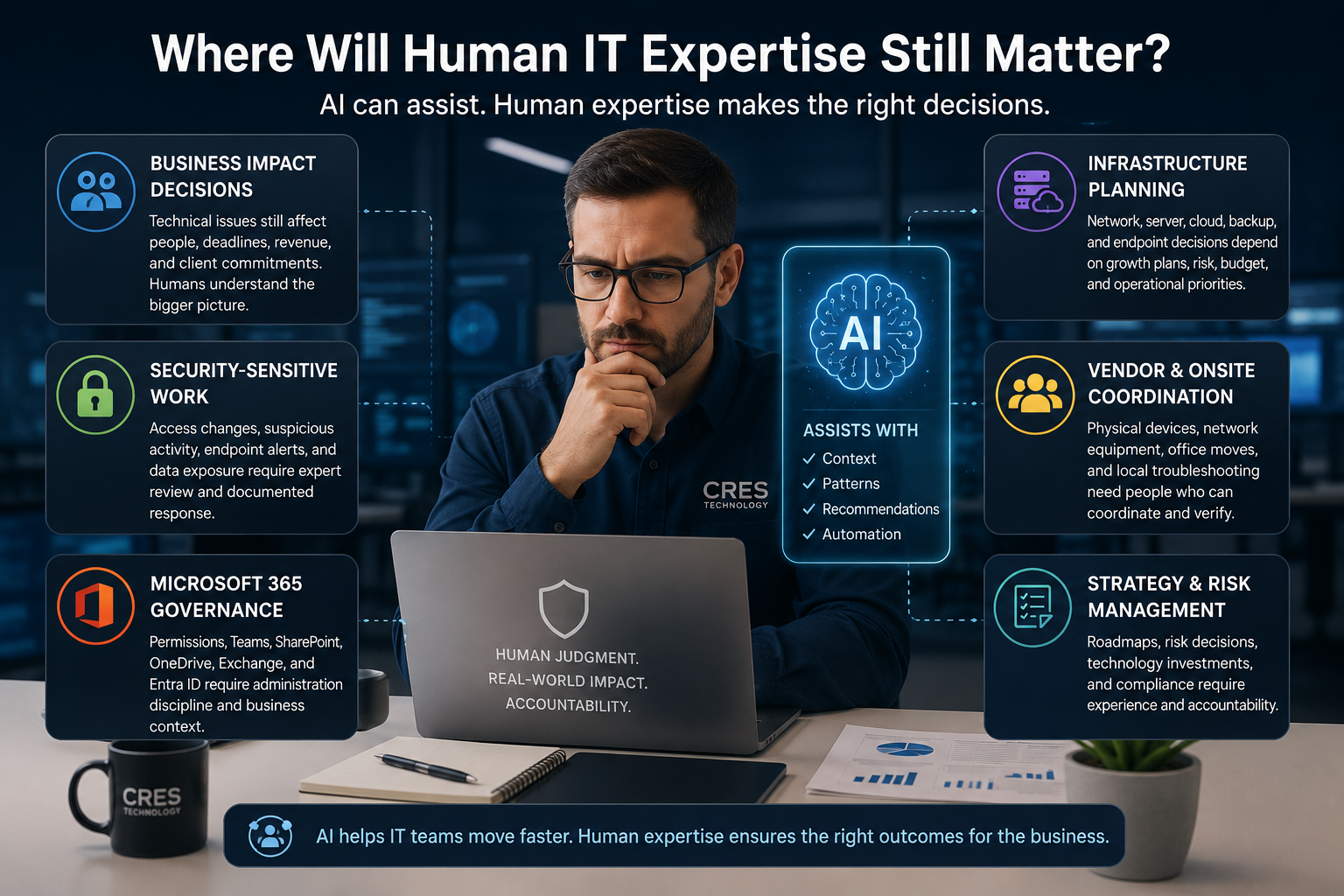
Where Will Human IT Expertise Still Matter?
AI can help support teams move faster, but it does not replace judgment. SMBs should be cautious about any support model that treats AI as a substitute for engineering experience, business context, or accountability.
- Business impact decisions: A ticket may look routine technically but still affect a critical meeting, client deadline, finance process, or executive workflow.
- Security-sensitive work: Access changes, suspicious sign-ins, endpoint alerts, and data exposure concerns need careful review and documented response.
- Microsoft 365 governance: Permissions, Teams, SharePoint, OneDrive, Exchange, and Entra ID require administration discipline, not only automated recommendations.
- Infrastructure planning: Network, server, cloud, backup, and endpoint decisions need context about growth, risk, budget, and operational priorities.
- Vendor and onsite coordination: Physical devices, network equipment, office moves, and local troubleshooting still require people who can coordinate and verify the work.
How Should SMBs Prepare for AI-Assisted IT Support?
SMBs do not need to rebuild their entire IT environment to prepare for AI-assisted support. They do need clean processes and reliable data, because AI is only useful when it works from accurate context.
- Document common support requests, escalation paths, and ownership rules.
- Review Microsoft 365 permissions, identity settings, and security configuration.
- Standardize endpoint management, patching, monitoring, and backup readiness.
- Track recurring issues instead of treating every ticket as isolated.
- Build a useful knowledge base that engineers can maintain and improve.
- Use reporting to identify delayed work, high-risk areas, and support bottlenecks.
What Should SMBs Look for in an AI-Enabled IT Support Partner?
When evaluating Managed IT Support for SMBs, business leaders should look for a partner that combines structured service delivery with practical AI-assisted capabilities. The strongest model keeps humans accountable while using AI to improve context, speed, and consistency.
- Clear intake, prioritization, escalation, documentation, and follow-up processes.
- Experience supporting Microsoft 365, endpoint environments, user access, networks, cloud services, and cybersecurity operations.
- Transparent reporting on ticket patterns, response bottlenecks, recurring problems, and operational risk.
- AI-assisted recommendations that support engineers instead of bypassing human review.
- Security-aware support practices across identity, endpoints, access control, monitoring, backup readiness, and response discipline.
- Flexible support capacity, including remote support, onsite coordination where needed, and strategic IT guidance.
Where CRES Technology Fits
CRES Technology helps businesses manage, support, secure, and improve their IT environments. For SMBs, that can include Managed IT Services, Microsoft 365 Support, Cybersecurity Services, Infrastructure Services, Virtual CIO guidance, Onsite Support, and Staff Augmentation.
CRES approaches AI in IT support as an assistant to skilled engineers, not a replacement for them. AI-assisted recommendations can help engineers work from better context, known patterns, documented troubleshooting guidance, and support history. Human oversight remains important for judgment, security-sensitive decisions, business impact, and follow-through.
Conclusion
Over the next three years, SMBs should expect AI to make IT support more contextual, proactive, and measurable. The practical value will come from faster triage, better documentation, clearer escalation, stronger pattern detection, and better visibility into recurring problems.
The right question is not whether AI will replace IT support. The better question is whether your support model is structured enough to use AI responsibly. Businesses that combine clear processes, strong Microsoft 365 administration, practical cybersecurity operations, and experienced IT support will be in a better position to benefit from AI-assisted service delivery.
How we can help!
CRES Technology helps businesses move beyond reactive support with structured Managed IT Services, Microsoft 365 Support, Cybersecurity Services, infrastructure support, Virtual CIO guidance, onsite support coordination, and staff augmentation. For teams evaluating AI-assisted IT support, CRES can help connect practical automation, reporting, escalation, documentation, and experienced engineer oversight into a service model that improves response quality without removing human judgment.
About Waqar Hussain

CRES Technology – Director of IT Services
A technology leader with outstanding knowledge, technical expertise, and a proven track record of leading complex infrastructure projects and managing help desk teams.