A helpdesk can look simple from the outside: a user reports a problem, someone responds, and the ticket eventually closes. In practice, the difference between an AI-powered helpdesk and a traditional helpdesk is not just speed. It is the difference between support that depends mainly on manual review and support that can use automation, pattern recognition, knowledge reuse, and human oversight together.
As founder and CEO of CRES Technology, I see this question becoming more practical for business owners, operations leaders, and IT managers. AI can help support teams triage requests, summarize context, recommend next steps, and identify repeated issues. It does not remove the need for experienced engineers. The strongest model is usually a well-governed combination of AI assistance and human technical judgment.
What Is a Traditional Helpdesk?
A traditional helpdesk is built around human support teams receiving, reviewing, assigning, and resolving user requests. This model has served businesses for decades because many IT issues require judgment, direct communication, and hands-on expertise.
- Human review: Technicians read each request, ask clarifying questions, troubleshoot the issue, and decide the next action.
- Reactive workflow: Most work begins after a user reports a problem, which means the business may already be experiencing downtime or disruption.
- Escalation paths: More complex issues move from first-level support to senior engineers, administrators, vendors, or onsite resources.
- Capacity limits: Response time depends on staff availability, request volume, documentation quality, and the complexity of the issue.
The traditional helpdesk remains important because users often need context-aware communication and technical judgment. Its weakness is that repeated manual review can make support slower and less consistent when ticket volume increases.
What Is an AI-Powered Helpdesk?
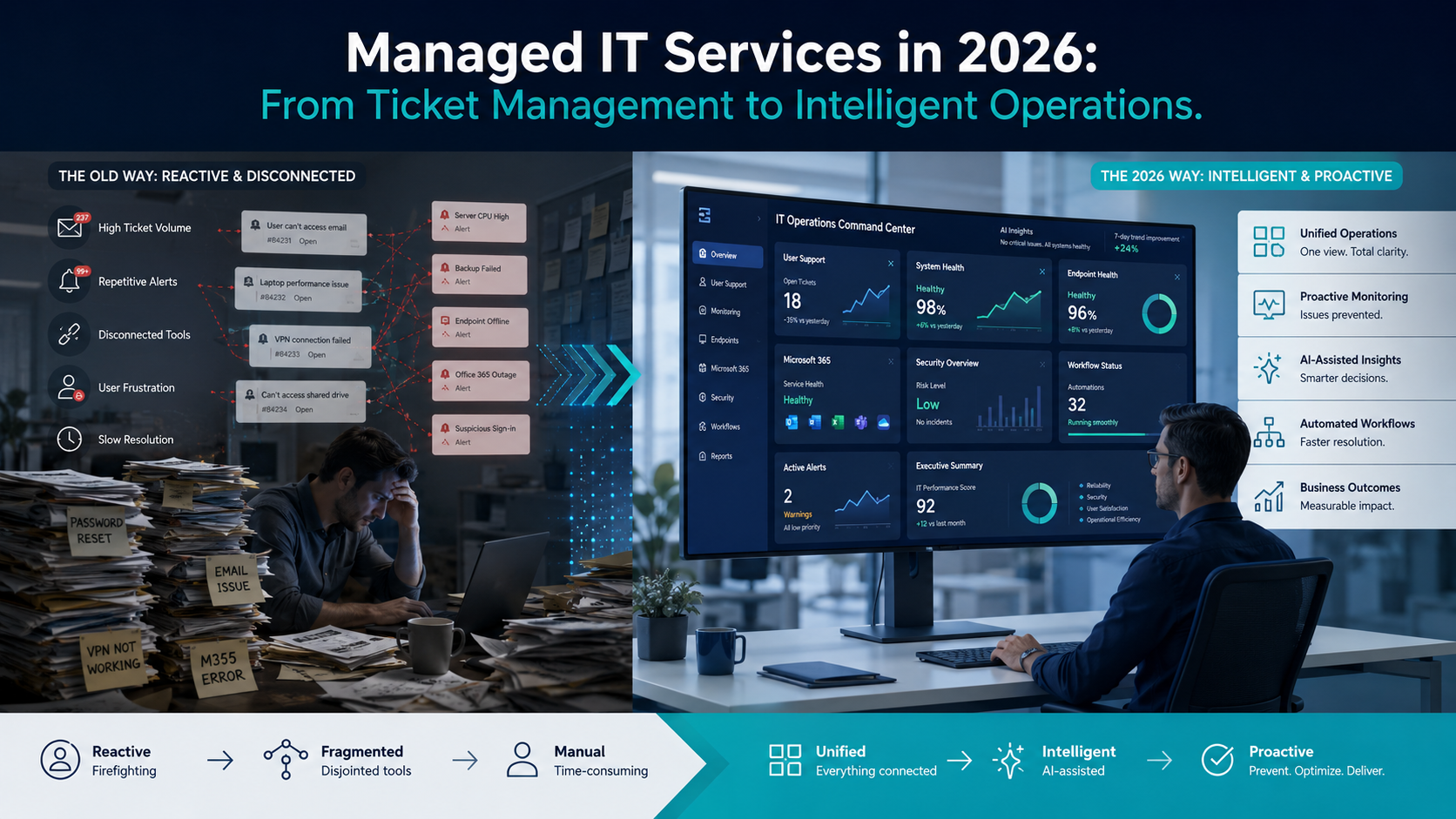
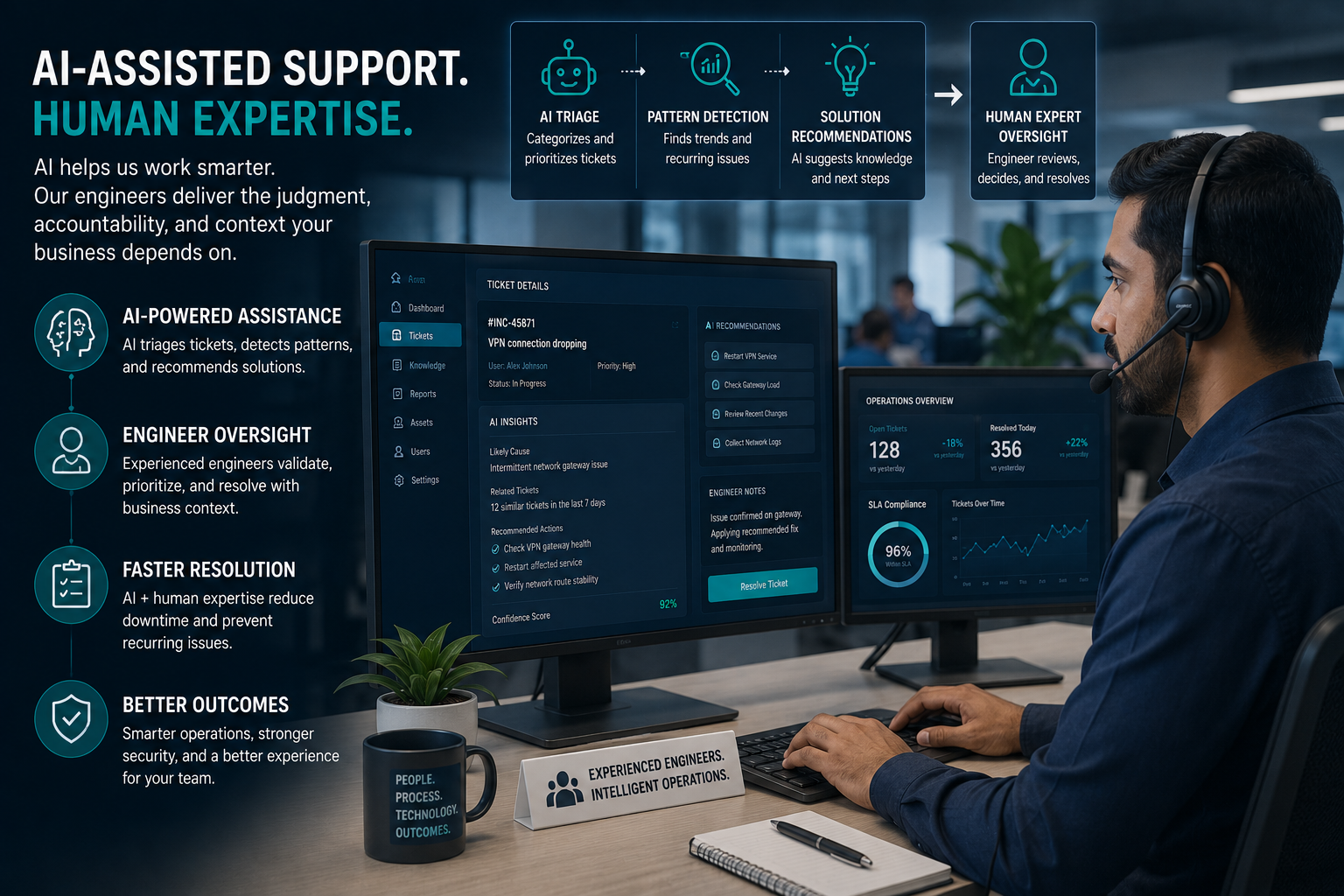
An AI-powered helpdesk uses artificial intelligence to support parts of the helpdesk workflow. That may include ticket classification, routing suggestions, issue summaries, knowledge article recommendations, chatbot responses, and pattern detection across recurring support requests.
- Ticket triage: AI can help classify requests by topic, urgency, user impact, and likely support category.
- Knowledge reuse: AI can suggest relevant troubleshooting steps or documentation based on the issue description and prior resolutions.
- Pattern recognition: AI can help identify repeated access issues, endpoint problems, application errors, or user-impact trends that deserve deeper review.
- Support summaries: AI can summarize long ticket histories so engineers can work from clearer context.
An AI-powered helpdesk is most useful when it improves context and consistency for the people responsible for support. It becomes risky if a business treats AI suggestions as final decisions without review, especially for access, security, data, or business-critical systems.
How Do AI and Traditional Helpdesks Compare?
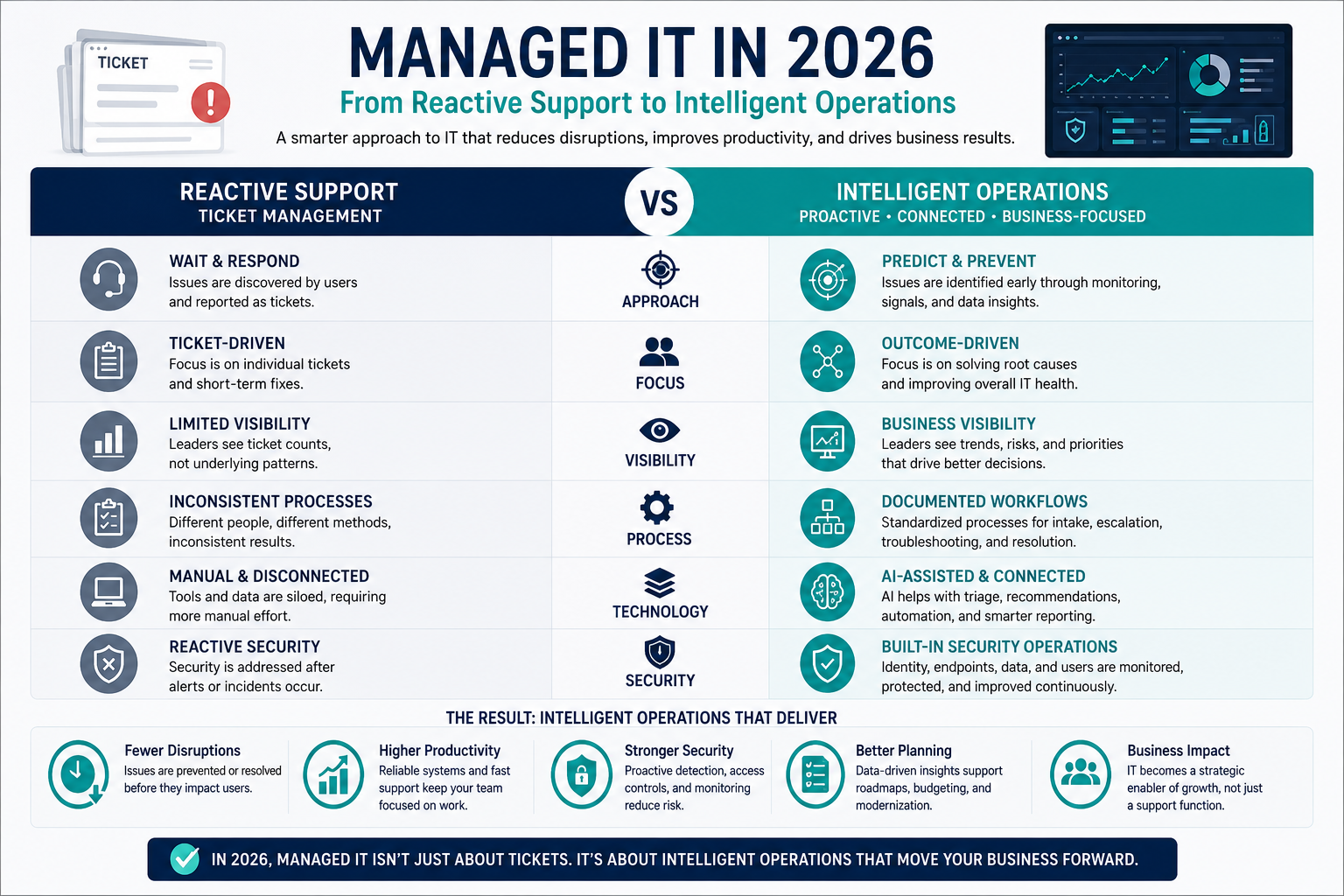
The practical difference is not that one model is good and the other is outdated. Each model solves a different part of the support problem.
- Speed: AI can help respond to simple questions, summarize tickets, and route common requests faster. A traditional helpdesk may take longer when every request requires manual review.
- Scalability: AI assistance can help support teams handle higher ticket volume with better organization, while a traditional model is more directly constrained by team size and availability.
- Consistency: AI can recommend standard troubleshooting steps and reuse approved knowledge. Traditional support can vary more depending on technician experience and documentation quality.
- Complex problem solving: Human engineers are still needed for nuanced troubleshooting, security-sensitive changes, vendor coordination, onsite work, and decisions that require business context.
- User experience: AI may improve speed and visibility for routine issues. Human support remains essential when users need empathy, judgment, escalation, or clear explanation.
For many organizations, the best answer is not AI versus people. It is AI helping people deliver more organized, consistent, and responsive support.
What Are the Benefits of AI for Helpdesk Operations?
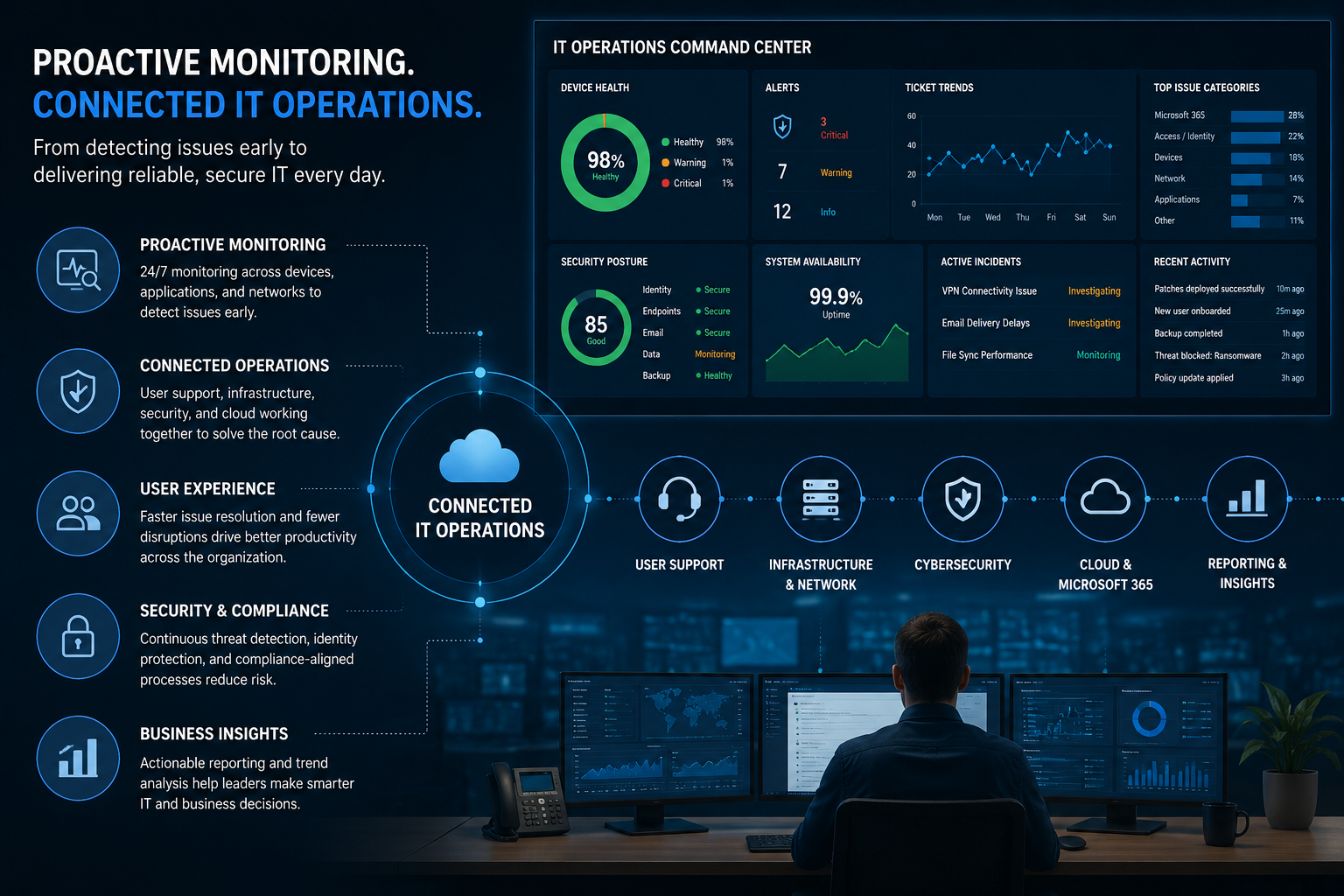
When implemented carefully, AI can strengthen helpdesk operations in several practical ways.
- Faster intake and routing: AI can help identify the type of issue and route it to the right support path sooner.
- Better engineer context: AI-generated summaries can reduce the time engineers spend reconstructing the history of a ticket.
- Improved knowledge use: AI can surface approved documentation, known fixes, and prior resolutions that may apply to the current issue.
- Recurring issue visibility: AI can help show when multiple users are reporting similar problems, which may point to a broader system, access, or configuration issue.
- More useful reporting: AI-assisted summaries can help leaders understand ticket themes, delayed work, and recurring operational risks.
These benefits matter because IT support is not only about closing tickets. It is also about reducing repeated disruption and helping leadership see where technology operations need improvement.
What Are the Limitations of AI in Helpdesk Support?
AI can support helpdesk operations, but it has limits that business leaders should take seriously.
- Complex issues still need engineers: Infrastructure problems, identity issues, cybersecurity concerns, and business-critical outages often require experienced technical review.
- Security actions require control: Password resets, access changes, account recovery, permission updates, and sensitive data issues should follow approved workflows and human oversight.
- AI depends on good data: Poor documentation, incomplete ticket history, or weak knowledge articles can lead to weak recommendations.
- AI can be confidently wrong: Suggestions should be reviewed before they are used for technical, security, or business-impacting decisions.
- Users still need communication: When an issue affects productivity, deadlines, or leadership visibility, clear human communication remains important.
The right expectation is that AI can assist support work. It should not be positioned as a replacement for accountability, engineering judgment, or security discipline.
How Should Businesses Decide Between AI and Traditional Helpdesks?
Businesses should start by looking at their actual support environment: ticket volume, recurring issues, user expectations, security requirements, Microsoft 365 dependency, endpoint management, remote work needs, and available IT expertise.
- Use AI for repeatable support patterns: Common questions, intake classification, knowledge recommendations, and summaries are good starting points.
- Keep humans responsible for high-impact work: Security-sensitive requests, complex outages, vendor escalations, and business-critical systems need human review.
- Measure operational value: Track whether AI improves routing, documentation, visibility, and consistency instead of focusing only on automation volume.
- Build governance: Define what AI can suggest, what it can automate, and what always requires human approval.
- Consider a hybrid model: A hybrid approach can combine AI-assisted speed with the expertise and communication of a traditional helpdesk.
A practical decision should be based on business risk and support quality, not on the assumption that every task should be automated.
Where CRES Technology Fits
CRES Technology helps businesses manage, support, secure, and improve their IT environments. Our work across IT Services, CRES Software, Staff Augmentation, Microsoft 365 support, cybersecurity, infrastructure, onsite support, and virtual CIO guidance gives us a practical view of how helpdesk operations connect with the rest of the business.
For helpdesk modernization, CRES focuses on using AI to support engineers and improve operational visibility. That can include better ticket context, recurring issue analysis, documentation support, reporting, and workflow improvement. The goal is not to remove people from IT support. The goal is to help support teams work from better information, respond with more consistency, and keep experienced human judgment involved where it matters.
If your organization is comparing an AI-powered helpdesk with a traditional helpdesk, the more useful question is how much structure, visibility, and governance your current support model provides. CRES can help evaluate that model and identify where AI assistance, process improvement, and human expertise can work together.
Conclusion
AI-powered helpdesks and traditional helpdesks are different because they organize support work differently. Traditional helpdesks rely on people to interpret, prioritize, and resolve requests. AI-powered helpdesk models can add speed, summarization, routing, pattern recognition, and knowledge reuse.
For most businesses, the strongest approach is a governed hybrid model: AI supports routine and repeatable work, while experienced engineers handle complex, sensitive, and high-impact decisions. That balance can improve support operations without losing the accountability and judgment that business technology still requires.
How we can help!
CRES Technology helps businesses move beyond reactive helpdesk support with structured Managed IT Services, Microsoft 365 Support, Cybersecurity Services, Infrastructure Services, Virtual CIO guidance, onsite support coordination, and staff augmentation. For teams evaluating AI-assisted IT support, CRES can help connect practical automation, reporting, escalation, documentation, and experienced engineer oversight into a service model that improves response quality without removing human judgment.
About Irfan Butt

CRES Technology – Founder and CEO
A strategic leader with over twenty years of progressive experience in Business Administration, Finance, Product Development, and Project Management. Irfan has a proven track record in a broad range of industries, including hospitality, real estate, banking, finance, and management consulting.